

The Community Compact: How Data Centers Can Earn the Right to Grow
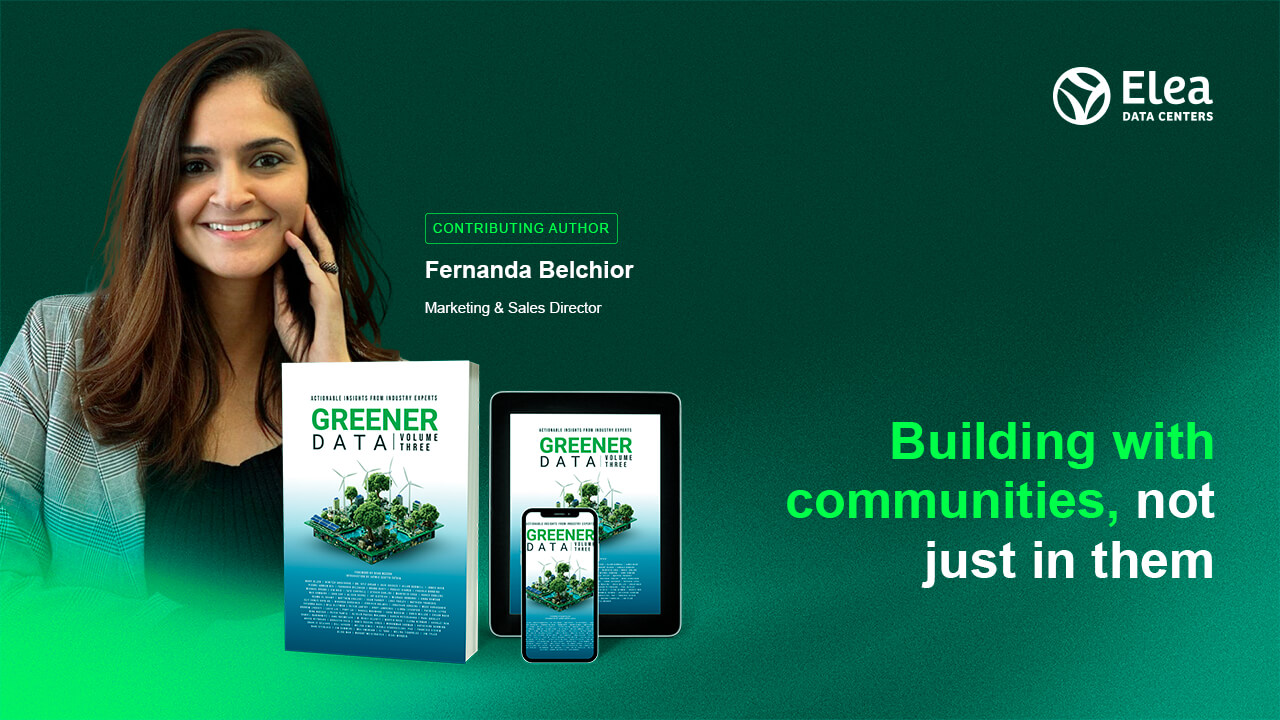
Key takeaways from A New Blueprint for Inclusive Digital Growth, a chapter of Greener Data by Fernanda Belchior of Elea Data Centers
AI infrastructure is a local challenge. The facilities powering national digital ambitions are built in specific neighborhoods, draw from specific water supplies, and strain specific power grids. And increasingly, the communities hosting them are saying no.
This tension has a name: the Data Center Paradox. Digital infrastructure essential to national competitiveness routinely meets local resistance. Visible costs, energy and water consumption, noise, and industrial footprint, land immediately. Benefits feel distant. When that gap isn’t addressed, communities stop seeing the digital economy as a partner and start seeing it as a costly neighbor.
The solution isn’t better messaging. It’s a fundamentally different approach to development. The blueprint, already being proven in Brazil, is built on three pillars.
See how this vision is being put into practice in Fernanda Belchior’s chapter for Greener Data.

Resource Transparency
Facilities must run on 100% renewable and certified energy and use closed-loop or waterless cooling systems. But technology alone isn’t enough. The industry’s most common failure isn’t inefficiency; it’s poor communication. When communities don’t know how a facility actually uses resources, distrust fills the gap. Clear, verifiable data on energy and water consumption is the only way to counter the perception that digital infrastructure takes more than it gives.
Community Investment
A responsible project enhances its surroundings. That means:
– Architecture that fits the local landscape, with green roofs, vertical gardens, and noise-reducing design;
– Surplus resources redirected to the community: spare power capacity, repurposed hardware for schools, clean water for municipal use;
– Workforce training programs in data management, network operations, and cloud architecture that create lasting local careers.
Governance by Partnership
The strongest proof of this model is currently taking shape in Rio de Janeiro. Rio AI City, planned for up to 3.2 GW of green capacity, was built through a formal alliance that includes:
– The local municipality
– Major energy distributors and generators
– Innovation partners focused on making the city’s entire power grid more resilient for residents and businesses alike
The project incorporates urban regeneration, reforestation, mixed-use development, and a direct pipeline of high-skilled local jobs. When city leaders and community representatives are part of the planning process from the beginning, they become advocates. The project becomes a shared asset rather than an imposed one.
Building With, Not Just In
The industry does not have to choose between scale and responsibility. Brazil is demonstrating that the two are entirely compatible when community partnership is treated as a core business requirement from day one, not a compliance obligation added at the end.
Digital infrastructure isn’t just a service. It’s a foundational force for fair, sustainable growth. The data centers that earn long-term permission to operate will be the ones that treat the communities around them as partners with a genuine stake in the outcome.
